AI is now your first meeting. Is your company profile ready for it?

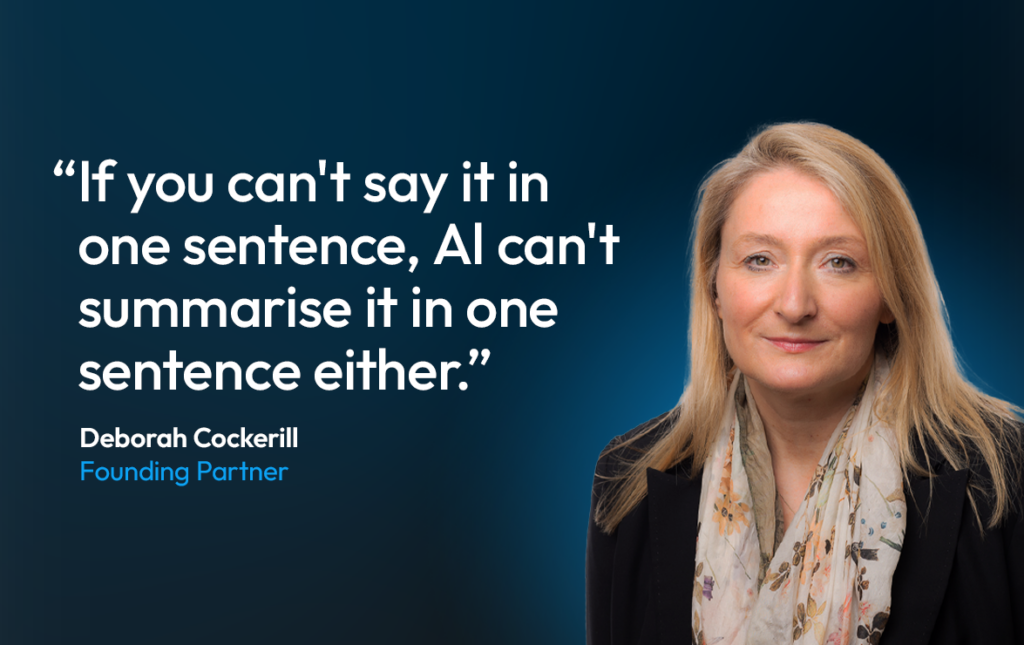
I recently had the pleasure of speaking at One Nucleus’s seminar, “Leveraging AI to Engage Your Top Investor and Partnering Targets”, hosted at J A Kemp in London. My session focused on something that sounds simple but that many life science companies still get wrong: crafting a company profile that secures meetings.
Thank you to One Nucleus for the invitation, and to everyone in the room for the brilliant questions. For those who couldn’t make it, here are the key takeaways.
The first reader of your profile is no longer a person
Partnering platforms, matchmaking tools and AI-powered search now surface your company before any human reads a word. Investors and business development teams use screening tools to rank and shortlist profiles long before a meeting request goes out.
In practice, that means three steps: they find you, they filter you, and only then do you get a diary invite. A thin, generic or inconsistent profile can be filtered out before you ever get the chance to be in the room.
The tools screening you have changed. The fundamentals of good communication haven’t.
Strategy first. Profile second.
Your company profile is an output, not the starting point. Before you write a word, agree your positioning: who you are, who you’re speaking to and why you’re different. Then decide the two or three messages you most want an investor or partner to walk away with.
A profile written without that strategy behind it will always read as generic, because there was nothing specific driving the words. As I put it on the day: if you can’t say it in one sentence, AI can’t summarise it in one sentence either.
Consistency is your brand’s backbone
One strategy. One set of messages. Repeated everywhere: your website, platform bio, one-pager, LinkedIn page and pitch deck.
When the facts, emphasis or tone shift from channel to channel, your brand gets diluted and trust erodes. Consistency compounds: repeat a message often enough and it becomes a reputation. A useful test is to ask whether your website, partnering bio and LinkedIn page could all be describing the same company today. Often the honest answer is no.
Machines are reading you as closely as investors are
AI tools scrape, summarise and rank the material you’ve already published. Your AI-generated summary is only as good as the words you feed it. Vague, inconsistent or jargon-heavy input produces a vague, inconsistent or simply wrong summary of your company. Clear, consistent language is represented accurately, wherever and by whatever is reading it.
Try it: type your company name into an AI search tool. Is the summary it produces the one you want an investor to read?
Tell your story to stand out
Investors and partners see hundreds of profiles at events like this, and a list of technology claims soon blurs into all the rest. Facts inform, but stories are remembered. Your story is the “why”: why this problem, why now, why your team and why it matters beyond the science.
Strategy and consistency get you noticed. Story is what gets you remembered, whether the shortlist is cut by a person or by an algorithm.
Five building blocks of a compelling profile
- Strapline: your memorable hook. Five to eight words, no jargon, no acronyms, and distinct enough to repeat from memory. (Ours at Sciad is “Bringing innovation to life”.)
- Subline: the promise behind it. One sentence that adds the “how” or “for whom”.
- Description: what you do, in plain language, written for a non-specialist’s first read rather than a peer reviewer’s.
- Framework & Technology: the platform, IP or approach behind your offer, explained in terms of the benefit it delivers, not just the mechanism.
- Impact: evidence, data, validation and traction. Investors back people first, so put your management team’s experience and track record front and centre, not in a footnote.
A simple test for each one: say it out loud. If it needs explaining, it isn’t working yet.
A quick checklist before you hit publish
- Does our strategy sit visibly behind every version of this profile?
- Is the messaging identical, word for word, across every channel?
- Would an AI summary of this profile say what we want it to say?
- Does the story explain why us, and not just what we do?
- Is the impact evidence, including our team’s track record, in there, rather than just adjectives?
This isn’t just theory
We see the results of this approach across our own client work at Sciad. Synpromics secured more than 100 pieces of coverage, including Bloomberg, the FT and Nature Biotechnology, ahead of its acquisition by AskBio and Bayer. Concinnity Genetics closed an oversubscribed £3m seed round, launched alongside more than 30 pieces of press coverage. Nuralogix saw an 82.75% increase in monthly leads. And KAUST’s coverage reached exactly the audience it was targeting in Chemistry World, where 52% of readers are academics and researchers.
What AI can’t give you
AI tools are useful, and they are here to stay. But they can’t give you verified results instead of generic claims, a human story instead of a template, or the relationships, timing and judgement that come from people who know your sector. That’s what turns a profile into a meeting.
If you’d like to talk about how your company profile is landing with investors, partners or the algorithms reading it first, I’d be happy to chat: Email: deborah@sciad.com.
Related Content:

Share
Got an innovation you need bringing to life?
We’d love to hear from you! Head to our contact page to start a conversation.