Capital, AI and China: Key Takeaways from Fierce Biotech @ London Life Sciences Week
Our key takeaways:
Europe’s biotech sector heads into 2027 with more capital, more deal-hungry pharma buyers and a new set of rules shaped by AI and China. That was the message from Fierce Biotech’s event at The Savoy, held as part of London Life Sciences Week.
Across four panels, investors, pharma dealmakers and biotech leaders kept returning to the same themes: funding follows clinical progress, AI is moving from experiment to an everyday tool, China is now a key part of the global innovation ecosystem, and the companies that win are the ones that can tell their story clearly. The Sciad team was in the room, and this is what we heard:
Opening remarks: funding, AI and the rise of Asia-Pacific
Keiko Oishi, President and Representative Executive Officer of CMIC Holdings, set the agenda around three forces: funding, AI and the growing role of Asia-Pacific in the industry.
Speaking about funding, her view was blunt. Money is going to companies that show clear clinical progress and a strong development plan. Investors want to know about the next milestone, what it will cost to reach and whether the management team can deliver it.
Moving on to AI, she described a shift from discovery into development, with agentic AI freeing people up to focus on higher-value work. Regarding geography, Keiko noted that Australia is strong for clinical trials, that sponsors increasingly choose trial locations based on patient access and speed, and that China has become a source of global innovation. She argued that capital, technology and a global outlook are the things that will bring new treatments to patients.
The state of biotech funding: optimism, with a European capital gap
The funding panel ended on a confident note for 2027, but not before naming Europe’s biggest structural problem. Moderated by James Waldron, Senior Editor at Fierce Biotech, it brought together Lena Afeyan (Head of UK Science Strategy & Innovation, Flagship Pioneering), Antoine Papiernik (Chairman and Managing Partner, Sofinnova Partners), James Machin (Managing Director, Healthcare Investment Banking, Morgan Stanley) and Søren Møller (Managing Partner, Seed Investments, Novo Holdings).
The timing was apt. The previous day, Sofinnova had announced the €725 million final close of its second crossover fund for late-stage companies, and earlier this year saw portfolio company Myricx Bio agree to be acquired by Novartis for up to $1.5 billion.
Management and modalities. James Machin said proven management teams, that have long been lacking in Europe, are now coming through. The industry remains asset-centric rather than platform-led, and oncology is enjoying a renaissance, proving a strong foundation for the next 12 months.
AI is now fundamental. Lena Afeyan said AI is central to Flagship’s strategy, with a team of around 50 people embedded across its company-building work, training 26 years of experience into the next generation of companies. Building from scratch with AI, she said, lets new companies capture advantages incumbents cannot. Antoine Papiernik described how Sofinnova reviews around 5,000 deals a year and how AI now gives a near-complete view of the field, identifying the needle in the haystack. Søren Møller added that the industry can no longer do things the old way and pointed to the interface between quantum computing and biotech as an emerging area.
China as “the central kitchen”. Papiernik called China “the central kitchen of the world”, offering quality and speed, while Europe still supplies the chef. Rather than a threat, he framed it as an opportunity Europe should embrace. Møller urged European companies to use their networks to get closer to Chinese innovation, while Machin said connectivity and partnering are the key pieces.
Is there enough money in Europe? “No” was Møller’s answer. He described a disconnect between what is possible and how risky people perceive it to be, noting that in France venture capital is literally called “capital risque”. European pension funds do not play in biotech the way US pension funds do. Europe is good at creating start-ups, he said, but struggles to grow them because only a handful of large investors can follow companies all the way through. Machin saw baby steps in the right direction, with better technologies and stronger management teams.
Nasdaq is the only game in town. With a boom in biotech IPOs, panellists agreed that Nasdaq remains the main listing route. Møller noted that around 80% of margin sits in the US, so European companies must think globally. The looming patent cliff means pharma is buying companies again, and companies should use every route available, from IPOs and reverse mergers to SPACs and pharma partnerships, to fund Phase 2 and 3. Afeyan added that early, long-standing pharma partnerships are another way to extend runway.
Looking to 2027. The outlook was upbeat. Machin expects open financing windows next year, with pharma and mid-caps both needing deal activity. Møller said investors are ready to put capital to work, and Papiernik predicted 2027 could be “an amazing year for Europe”, combining Chinese speed with US capital.
Getting noticed: why the story matters as much as the data
For early-stage companies, good data is the entry ticket, not the differentiator. That was the clear consensus of the panel on how to attract investors and partners, moderated by Ravi Moorthy (Managing Director, Global Corporate Lead, GCI Health) with Bommy Lee (Head of Communications, Sofinnova Partners), Sotirios Stergiopoulos (Executive Chairman, Coiled Therapeutics) and Matthew Brown (Senior Director, Alliance Management, GSK).
Stand out beyond the data. With thousands of deals crossing an investor’s desk each year, Bommy Lee said what moves the needle is reputation, communications and brand. Coming from a journalism background, she sees great science and great founders every day, but people are not always good at telling their story. Being able to articulate it well, she argued, is a competitive advantage.
The CEO must own the story. Sotirios Stergiopoulos was direct: unless you can pitch your story well, it is gibberish to investors. He described his own journey from big pharma to leading a small company, where you build the culture and investors are ultimately backing you, your belief and your track record. Once uncomfortable with public speaking, he found that telling a story you are living gives you credibility.
Partnering is like a marriage. Matthew Brown said everyone thinks they have great data, so the real work is in building relationships over time and bringing partners along on the journey. Trust is critical: holding information back creates problems later. The earlier communication starts, the better, especially as an asset moves into a larger portfolio and its future is decided.
Not a megaphone, a magnet. Lee described communications as far more than PR. It is the face and collective identity of the company, and it matters internally as much as externally, setting the benchmark for everyone who works there. Comms, she said, is a safety net for the future and should be built into everything a company does.
Advice for founders. Brown advised companies to understand who they are targeting, what those people care about (GSK is currently focused on oncology, for example) and to stay in touch over time. Stergiopoulos reminded the room that most deals still happen in the US, and that small, steady wins build momentum. Lee closed with a principle that resonates strongly with us at Sciad: this is a people business, so build relationships before you need them and make communications part of your toolkit from day one.
AI in drug discovery: better data, not just better models
The AI panel agreed AI is already changing drug discovery, but argued that the real bottleneck is data and culture rather than algorithms. Speakers were Ghazanfar (Sunny) Khan (Chief Medical Officer, Evidation), Fred Manby (Co-founder and CTO, Iambic), Ben Taylor (CFO and President of UK, Recursion) and Justin Scheer (Vice President of In Silico & Biologics Discovery, Johnson & Johnson), who led the discussion.
Understanding biology. Ben Taylor described AI as a tool for modelling a complex, systemic problem. Existing drugs touch only a small part of the genome, and he cited a figure of 87% that has yet to be associated with a drug. Models of the cellular environment, gene knockouts and systems biology can reveal links between previously unrelated events.
Organising messy chemistry. Fred Manby shared how, in one Iambic programme, the team made many molecules that inhibited multiple targets in a messy way. AI organised that information and surfaced a viable candidate.
Building data on purpose. Sunny Khan argued for being precise about the question first: what data, from whom, when and how. He described an Evidation study in rheumatoid arthritis that recruited a cohort to report flares in real time, combining wearable data with samples taken during flares and proteomic analysis. The point, he said, is to build the data architecture that is most valuable for biology. Justin Scheer framed this as a change of mindset: data is an asset.
Culture is the hard part. Manby said the biggest challenge is bringing people along as an organisation scales, because under pressure people revert to what they know. He advocated investing equally in fast data generation and AI so that drugs can be made more efficiently. Khan saw silos beginning to break down, with cross-sector partnerships becoming important.
Raising the success rate. Taylor pointed to the industry’s roughly 95% failure rate and said it is not acceptable to keep failing at that level. The panel agreed the industry has a responsibility to do better.
“AI-discovered” drugs? Insilico Medicine’s Rentosertib, whose target and molecule were both identified with AI, entered Phase III in July for idiopathic pulmonary fibrosis. Scheer noted there are many examples of AI contributing to pipelines. Manby offered a note of caution on the label itself: drugs are discovered by people, some of whom use AI.
Where big pharma is placing its bets: science first, geography second
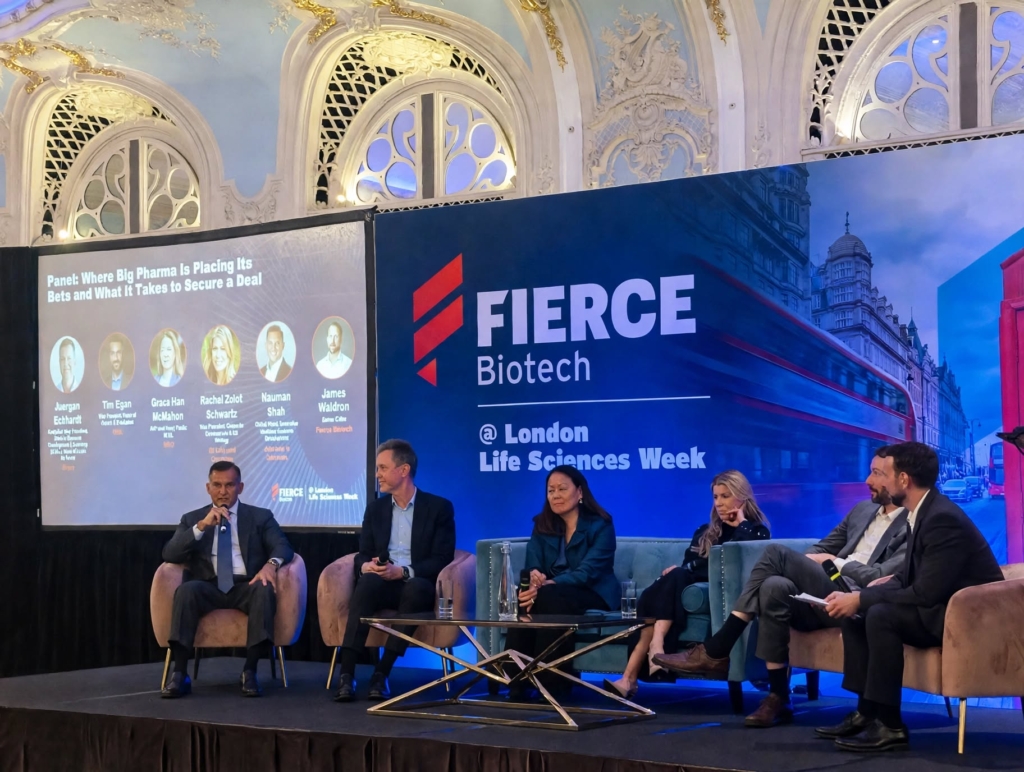
Pharma dealmakers said they are geographically agnostic and driven by science, and that transparency is what gets a deal done. James Waldron moderated a panel of Juergen Eckhardt (EVP, Head of Business Development & Licensing and Head of Leaps by Bayer, Bayer), Tim Egan (VP, Head of Search & Evaluation, GSK), Grace Han McMahon (AVP and Head, Pacific BD&L, MSD), Rachel Zolot Schwartz (VP, Corporate Development & BD Strategy, Eli Lilly and Company) and Nauman Shah (Global Head, Innovative Medicine Business Development, Johnson & Johnson).
Why they deal. Nauman Shah said J&J is in a strong R&D position, targeting double-digit growth by the end of the decade without external deals, so partnering is driven by science of interest. Tim Egan said GSK invests early to soften future patent cliffs and to move into new and exciting science.
Deal structures. Rachel Zolot Schwartz described deal structure as a tool that can evolve, starting with scientific diligence. Lilly began with a licence in ADCs and now has 16 assets, taking it into tumour types competitors were not in. Juergen Eckhardt said Bayer’s approach is to buy innovation powerhouses and keep them intact and separate from the larger organisation, as it has done with BlueRock.
China is part of the global picture. GSK sees a high volume of opportunities from China, supported by a team in Shanghai. Lilly has no specific China policy, treating it as part of a global approach, and MSD said that it is agnostic about where deals come from. Eckhardt, who visits China three or four times a year, called it a major innovation powerhouse that is adding to the global ecosystem. Panellists noted that China’s pipeline includes many “me-too” and “me-better” assets, but that bispecifics, cell therapy and gene therapy are particularly strong, with J&J’s CAR-T Carvykti, originally developed in China, cited as an example.
What it takes to secure a deal. Transparency came up again and again. Egan warned against withholding information. Schwartz said full information upfront allows pharma to de-risk and start the relationship on the right foot. McMahon advised biotechs to make the most of their BD contact, noting that internal negotiations within pharma can matter as much as external ones. Eckhardt said there is no need to be overly forceful: pharma has to prioritise your asset against others, and an asset meeting a clear unmet medical need will get the deal done. Egan closed by encouraging early engagement and ongoing conversation, adding that biotechs generally run a very good ship.
Sciad’s view
The common thread across every session was that science alone is not enough. Investors want a clear plan to the next milestone, pharma wants transparency and early engagement, and both want leadership teams who can explain why their asset matters. With capital returning, pharma buying and the IPO window open, 2027 looks set to reward European biotechs that communicate as well as they innovate.
At Sciad, this is the work we do every day: helping life science companies build their story, their reputation and the relationships that turn great data into investment and partnerships. If you would like to talk about what these trends mean for your company, get in touch.
Sources


Got an innovation you need bringing to life?
We’d love to hear from you! Head to our contact page to start a conversation.